In most rented homes a wasp nest falls to the tenant to sort out — unless the tenancy agreement says otherwise, or the wasps got in through a defect in the fabric of the building. A hole in a soffit, a slipped tile, a broken air brick grille or a gap left behind by works is a repair, and repairs are the landlord's. If that is where your nest is, you have a straightforward case rather than a favour to ask. The rest of this page is how to tell which of the two you are in, and how to get the nest treated this week instead of after a fortnight of emails.
The short version
- Nest in a garden shrub, a fence post, or a shed you use: normally the tenant's to arrange.
- Nest inside the roof void, a wall cavity, a soffit or under the floor: it got in through the structure, so make the case as a repair.
- Tenancy names pest control as the landlord's: then it is the landlord's, whatever the cause.
- Anyone in the household with a known sting reaction, or small children in the garden: raise it in writing as a safety issue, immediately.
- Flat in a block: a nest in the roof or a communal area is usually the managing agent's, not your landlord's.
- Either way, nobody needs to front the money: we invoice the landlord or letting agent direct once they approve it in writing.
Is a wasp nest the landlord's responsibility?
The reason every article on this subject ends on "it depends" is that a wasp nest is not, in itself, a repair. It is an insect colony that turned up. What can be a repair is the hole it flew through.
Landlords generally have to keep the structure and exterior of a let property in repair — that obligation sits in section 11 of the Landlord and Tenant Act 1985 and is written into the vast majority of assured shorthold tenancies. Rotten fascia, a missing slate, an air brick with the grille kicked out: those are defects whether or not anything is nesting in them. Once a colony is living behind that defect, the treatment and the repair are one job, and it is reasonable to ask the landlord to carry both.
In England, the Homes (Fitness for Human Habitation) Act 2018 also matters where an infestation is bad enough to make a home genuinely unfit to live in. That is a higher bar than a nest at the end of the garden, and it is not the argument to reach for first — but it is why an agent tends to take a nest over the front door more seriously than a nest in a hedge.
The building-fabric test, in plain terms
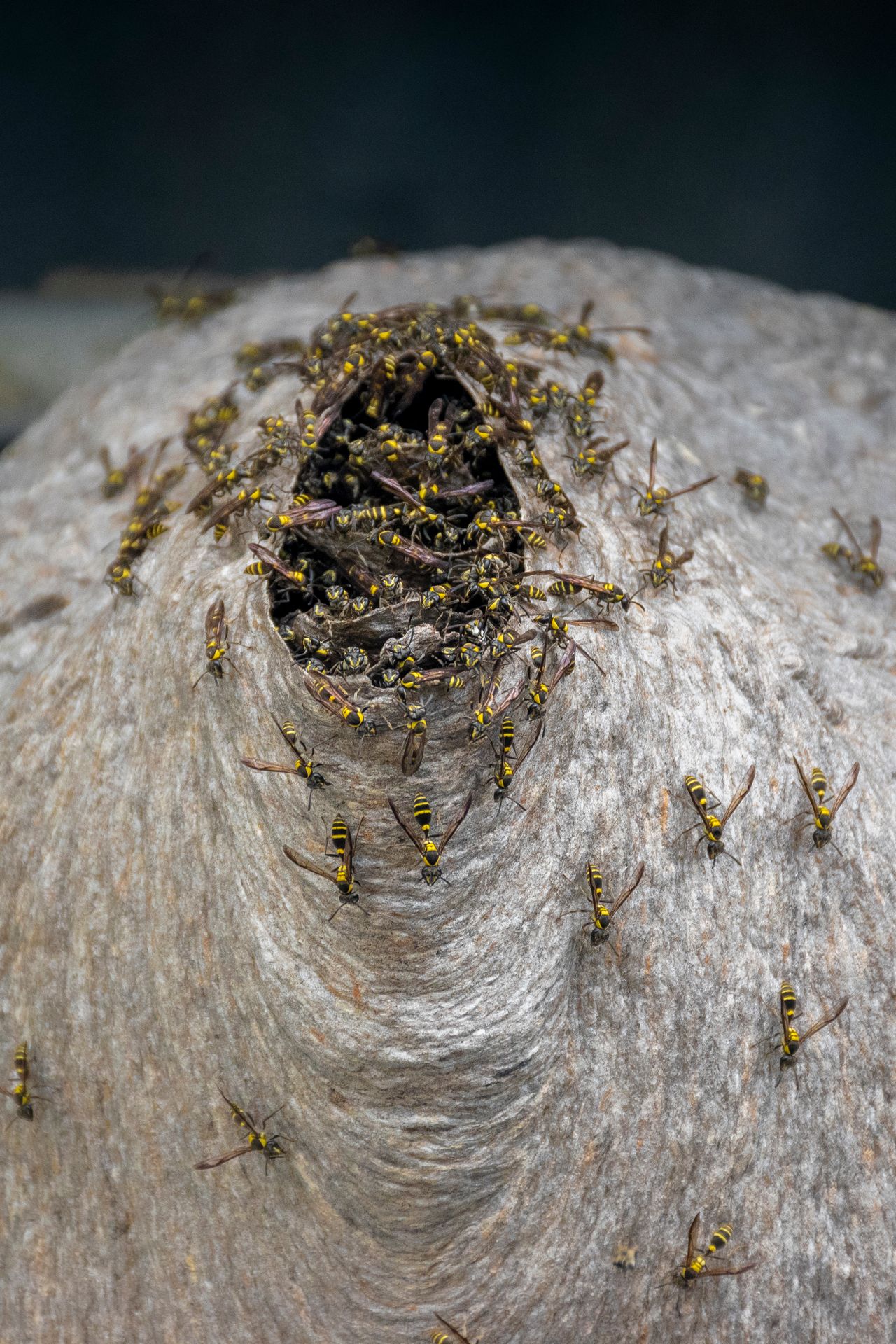
Stand outside in decent light and watch the flight path for two or three minutes. Wasps working a nest fly in straight, purposeful lines to one fixed point, usually a gap no bigger than a 2p coin. Where that point is decides the conversation. These are the landlord's:
- A hole or soft rot in the soffit or fascia. The single most common entry on Manchester semis and terraces, particularly where timber boards have never been capped.
- A slipped, cracked or missing roof tile. Wasps use the gap; so does the rain.
- A broken or missing air brick grille. Straight into an under-floor void, and cheap to put right.
- A gap left by works. Boiler flue, cabling, solar brackets, replacement windows — anything drilled through the wall and not made good.
- Perished mortar or an open cavity at the eaves. Common on older brick terraces where the roof line has been patched rather than rebuilt.
- A disused chimney with no cowl. An open flue is an open door.
Take a photo from the ground with the zoom on, note the date, and say in your email exactly where the wasps are entering. "There is a wasp nest" invites a shrug. "The wasps are going in under the third soffit board from the left, where the timber has rotted through" is a repair report.
What to look for in your tenancy agreement
Before you email anyone, spend five minutes with the agreement. On a standard assured shorthold tenancy the answer is usually in one of four places:
- The landlord's obligations or repairs clause. Look for wording about the structure, the exterior, the roof, and the installations. This is where a fabric defect lands.
- The tenant's obligations clause. Many agreements ask the tenant to keep the property clean and free from infestation. That wording is what agents point at when they push a nest back to you.
- A named pest control or infestation clause. Not every agreement has one, but where it exists it settles the question outright — sometimes by naming a threshold, such as anything arising after the first month of the tenancy.
- The inventory and check-in report. If the nest was already active when you moved in, that is a condition-at-the-start argument and a strong one.
Flats have a fifth place to look. If the building is leasehold, the roof and the common parts are usually the freeholder's or the managing agent's, not your landlord's, and your landlord may need to pass it up the chain. That is worth knowing before you accept a no.
When someone in the house reacts badly to stings
Most wasp stings cause sharp pain, redness and local swelling that settles within a day or two. A small number of people react severely, and anyone carrying a prescribed adrenaline auto-injector for insect stings is in a different category altogether. Wasps do not lose their sting, and a colony defending its nest will sting repeatedly.
If that describes someone in the household, say so in the first line of your email, and say it plainly: who is at risk, what they are prescribed, and where the nest sits relative to the door, the bins, or the garden the children use. It changes the request from an inconvenience into a risk the landlord now knows about in writing. In our experience that is the single thing most likely to get a same-day approval out of a letting agent.
The same applies to a nest over the only entrance, above a pushchair ramp, or at head height on a shared path. Nobody has to argue that a colony is dangerous if the household cannot get past it.
If the landlord or letting agent will not act
- Put it in writing. Email, not a phone call. State the location, the entry point, anyone at particular risk, and a reasonable date by which you need it dealt with. Attach the photo.
- Chase once, in the same thread. A single thread with dates in it is worth more later than six separate messages.
- Contact the council. Every local authority has a private-sector housing or environmental health team that assesses hazards in rented homes under the Housing Health and Safety Rating System, which covers pests. They can inspect and, where a hazard is found, require the landlord to act. Find yours through GOV.UK.
- Keep paying the rent. Withholding rent to force the issue turns one dispute into two.
We treat nests; we are not qualified to interpret your tenancy agreement and nothing here is legal advice. Shelter and Citizens Advice both give free, specific advice on a particular agreement, and the landlord-sector bodies publish their own guidance — worth reading if you want to know how the other side of the conversation sees it.
We invoice the landlord or letting agent direct
This is the part nobody else seems to offer, and it removes the whole argument. If the landlord or agent approves the job by email, we attend, treat the nest, and send the invoice to them. The tenant pays nothing, and has nothing to claim back.
To authorise it, an agent needs four things, all of which fit in a two-line reply:
- The property address and postcode.
- A mobile number for whoever can give access — normally the tenant. We do not need the landlord to be there.
- Written confirmation that the £60 fixed fee is approved — an email is enough.
- An invoice email address, plus a purchase order or job reference if the agency uses them.
There is no survey stage, no quotation, and no call-out charge on top. The fee is £60 for a wasp or hornet nest anywhere in Manchester and Greater Manchester, including evenings and weekends, and it includes a free return visit if the nest is not fully destroyed first time. We are not on anybody's approved contractor panel and do not claim to be — most approvals arrive as a short email from a property manager who wants the job closed before the weekend.
Something you can forward, as is
Subject: Wasp nest at [address] — request to approve treatment
There is an active wasp nest at [address]. The wasps are entering at [where], which appears to be [the defect]. [Who is at risk, if anyone.] I have found a local firm that treats wasp nests for a fixed £60 and will invoice you direct — I do not need to pay anything up front. Please confirm by reply that you approve the £60 fee and give me an invoice address, and I will arrange access.
Attach the photo of the entry point. Most replies come back the same day.
HMOs, student houses and shared lets
Around Manchester the shared-housing belt is the one place where this gets genuinely tangled. In M14 through Fallowfield and Rusholme, and M13 around Longsight and Victoria Park, the stock is long Victorian and Edwardian terraces with a continuous roof line, deep timber soffits, and loft conversions with dormers cut into them. One colony in a shared roof void can sit above two or three households at once, and the wasps will happily use a neighbour's rotten fascia as the front door to your ceiling.
Two practical points. First, on a joint tenancy the bill is not one housemate's problem — do not let the person who noticed it end up paying. Second, in a licensed HMO the licence conditions typically cover the common parts and the structure, so the named manager, not a student, is the person to sign it off. Ask the letting agent for the manager's details if you are not sure who that is.
Where the nest is genuinely in a neighbouring property's roof, that neighbour's landlord has to authorise it. We will tell you honestly if that is what we find on arrival rather than treating the wrong building. We cover the shared-housing districts as standard, including Fallowfield, Rusholme and Withington.
When you do not need to call anyone
Plenty of these situations do not need a treatment, a landlord, or an invoice. If you are in one of them, save everyone the trouble:
- It is a bumblebee nest. Large, very furry, slow and noisy, and gone by autumn on its own. A bumblebee colony can almost always be left alone to die back naturally, and nothing needs to be paid by anyone. Treatment, where a nest genuinely blocks a doorway or puts a vulnerable person at risk, is £70 fixed.
- The nest is grey, papery and silent. Wasp nests are single use. Last year's nest is empty, will never be reused, and can be taken down safely by anyone once you are certain it is dead.
- It is late October and the nest is at the bottom of the garden. The colony is already collapsing and will be finished within weeks. If nobody has to walk past it, waiting is a reasonable answer.
- It is a honeybee swarm. A dense football of bees hanging on a branch or fence is a swarm, not a nest. We do not treat honeybees at all — a local beekeeper may collect a swarm, and your council or a local beekeeping association can point you at one.
- It is not wasps. We treat wasp, hornet and bumblebee nests, and nothing else. If the tenancy dispute is about mice, ants or anything else, we are the wrong firm and will say so on the phone rather than send someone out.
Hornets, incidentally, are simply large wasps and are treated the same way for the same £60. They look alarming and are generally less inclined to bother you than a common wasp, but a nest in a roof void is still a nest in a roof void.
Renting, and there is a nest?
£60 fixed fee, same-day across Manchester and Greater Manchester. Tell us it is a rented property and we will invoice the landlord or letting agent direct once they confirm by email — you do not pay anything up front. Call 07770 015197.
Call to BookSources and further reading
- GOV.UK — Private renting: repairs
- GOV.UK — Find your local council
- National Residential Landlords Association
- Shelter England — Housing advice
This page is general information for tenants, landlords and letting agents in England. It is not legal advice and we cannot interpret the terms of a specific tenancy agreement. For advice on your own agreement, speak to Shelter, Citizens Advice, or a solicitor. Last reviewed: July 2026.
Frequently Asked Questions
Usually not, unless the tenancy agreement says so or the wasps got in through a defect in the building. A nest in a garden shrub or a shed is normally the tenant's to sort out. A nest inside the roof void, a wall cavity or a soffit got there through a gap in the structure, and keeping the structure and exterior in repair is generally the landlord's job.
In most cases the tenant pays, unless the tenancy agreement puts pest control on the landlord or the nest is linked to a disrepair. In practice a lot of landlords and letting agents will simply approve the cost when asked in writing, because a treated nest is cheaper than a damaged ceiling and an unhappy tenant.
Put the request in writing, give a reasonable deadline, then contact your council's private-sector housing or environmental health team if nothing happens. Councils assess hazards in rented homes and can require a landlord to act. Keep every email and photo. Do not withhold rent over it — that creates a separate problem.
Not safely, no. Withholding rent or deducting the cost without agreement has strict conditions attached and getting it wrong puts you in arrears. Get written approval before the work is done, or ask for reimbursement afterwards with the invoice attached. Better still, have the invoice sent to the landlord or agent so no money leaves your account at all.
Yes. If the landlord or letting agent emails approval, we treat the nest and invoice them — the tenant never pays anything and never has to claim it back. We need the property address, a mobile number for whoever can give access, and one line confirming the £60 fixed fee is approved.
Ask the letting agent or the person named as the manager on the HMO licence before anyone in the house pays out of pocket. On a joint tenancy the cost is not one housemate's problem, and where the nest is in a shared roof void or affects the common parts it usually sits with whoever manages the building.
£60 fixed, the same as any other property — no landlord surcharge, no call-out fee, no quotation stage. It covers the visit, the treatment and a free return if the nest is not fully destroyed first time. The figure is deliberately simple so an agent can approve it from an email without asking for a quote.