A wasp nest in a cavity wall or behind an air brick is treated from outside, at the hole the wasps are already using. The wall is not opened, nothing is drilled, and no plaster comes off inside. It is one visit and the same £60 as a nest in a loft or a hedge — and in most cases nobody needs to come into the house at all.
Why the wall never gets opened
People expect this job to involve scaffolding, a bolster and a bag of cement. It does not. A wasp colony has one working entrance, and every forager passes through it dozens of times a day. Put an insecticidal dust into that entrance and the wasps distribute it through the nest themselves, walking it in on their legs and bodies and spreading it by contact and grooming inside a crowded colony.
- The entry point is the treatment point. Nobody has to see the nest, reach it, or know exactly how far back it sits.
- Nothing is drilled or removed. The air brick, the grille, the meter box and the pointing all stay as they are.
- Access is usually external only. If the hole is reachable from the garden, the pavement or a ladder, that is the whole job.
- It is a single visit. The colony collapses over the following hours rather than instantly, but nobody needs to come back to finish it.
This is also why a cavity nest costs the same as any other. There is no extra charge for it being in a wall, and none for the ladder.
How wasps get into the wall of a Manchester house
The route depends almost entirely on when the house was built, and Manchester has two very distinct sets of stock sitting side by side.
Victorian and Edwardian terraces
The red-brick terraces across Levenshulme, Chorlton and the older streets around Northenden village mostly predate cavity construction. The walls are solid nine-inch brick, so when someone says the wasps are in the cavity, what they usually have is a nest in the void under a suspended timber ground floor, or in the cellar head. The ways in are consistent:
- Low-level air bricks. Set a few courses above the ground at the front bay and in the back yard, venting the floor void. A cracked or half-missing one is an open door.
- Cellar grilles and pavement lights. Old iron grilles rust through at the bars, and the frame around them opens up long before the grille itself fails.
- Coal chute reveals. Bricked up or slabbed over decades ago, rarely sealed properly, and often left with a finger-width gap at one edge.
- Perished pointing. Soft lime joints on an exposed gable wear back, and on a nine-inch wall that can eventually be a route right the way through.
- The bay roof junction. Where the little flat or leaded roof over a bay meets the main wall, the flashing lifts and the joint behind it opens.
Interwar and 1930s semis
The bay-fronted semis through Burnage, Withington, much of Northenden and the Kingsway side of Didsbury are genuine cavity construction, and they fail in different places:
- The return at the side of a bay. The narrow section of wall where the bay turns back into the house is the most awkward bit of brickwork on the elevation and the most likely to have an open cavity behind it.
- The external meter box. A box cut into the outer leaf leaves a void behind it that is frequently open to the cavity. Wasps go in around the door seal.
- The junction with a later extension. Where a kitchen or side extension meets the original wall, the vertical joint is rarely sealed the whole way up. The original outer leaf is now an internal wall with its cavity opening into a new roof void.
- Weep holes and open perpends. The deliberate gaps left above lintels and at damp-proof course level. They are supposed to be open — that is their job.
- Air bricks again. Interwar semis usually have suspended timber ground floors too, so the same low-level route exists.
The thing that turns this into an indoor problem
Do not foam, tape, cement or board over the hole the wasps are using while the colony is alive. It is the single most common way this goes wrong.
A sealed colony does not give up and die quietly. Wasps chew — that is how they build the nest in the first place — and when the way out is blocked they work at whatever is softest. From inside a cavity or a floor void, the softest thing available is almost always the inside of your house: the paper face of a plasterboard ceiling, the gap where the floorboards meet the skirting, the hole a socket back box sits in, or the loose collar around a pipe.
The wasps then come out on the inside, at ground-floor level, in a room you are sitting in. That is a materially worse position than the one you started with, and it is entirely self-inflicted. If you want to stop wasps getting from the void into the room, seal the internal openings — tape over a downlighter trim, stuff the gap under the skirting. Never seal the external one.
Air bricks are there for a reason
There is a second reason not to foam an air brick, and it outlives the wasps. An air brick is not decorative. It ventilates the void under a suspended timber floor, and that through-draught is what keeps the joists and floorboards dry. Block it permanently and you get still, damp air under the floor, then condensation, then rot in the timbers — a slow and genuinely expensive problem, traded for a wasp colony that would have died off by itself in the autumn.
The ventilation expected under a suspended ground floor is set out in the Building Regulations guidance rather than being a matter of opinion. The relevant document is Approved Document C on GOV.UK, which covers resistance to moisture in floors and walls. If a grille has to be replaced, it gets replaced with another grille.
Is it the wall, or the eaves directly above it?
This matters, because the treatment point is different even though the price is not. Wasps drifting down the face of a wall from a nest in the soffit look very much like wasps using an air brick. Four checks sort it out:
- Watch the height for three minutes. Warm, bright, mid-afternoon. A working entrance produces two-way traffic at one fixed point — arrivals dropping straight in without hesitating, departures leaving on a consistent line.
- Watch the approach. Wasps going home dive in. Wasps merely investigating a hole hover in front of it, wander sideways and give up.
- Note where the dead ones turn up inside. Ground-floor windowsills point at a floor void or a low cavity. Landing and bedroom sills point at the roof.
- Listen. A large colony is audible as a soft continuous rustle. Ear low against the wall for a cavity nest, against the ceiling of the upstairs room for an eaves nest.
If you genuinely cannot tell, that is fine — it is not your job to diagnose it. Point at the activity and it gets worked out on site, at no extra cost for guessing wrong.
Is it definitely wasps?
Bumblebees use air bricks and under-floor voids constantly, and a bumblebee colony behind an air brick usually needs nothing doing to it at all. They are big, furry, slow and audibly heavier in flight, they come and go in ones and twos rather than a stream, and they have no interest in defending the entrance unless you stand on it. A bumblebee colony dies back naturally by the end of the summer and does not return to the same spot, so leaving it alone is normally the right answer — we will say so on the phone. Where one truly has to be dealt with, that job is £70. See the identification guide or the bumblebee page.
Honeybees are not something we treat. If what you have is a tight, constant, brown-and-amber stream, or a swarm hanging in the open, a local beekeeper may be able to collect a swarm.
What is left in the wall afterwards
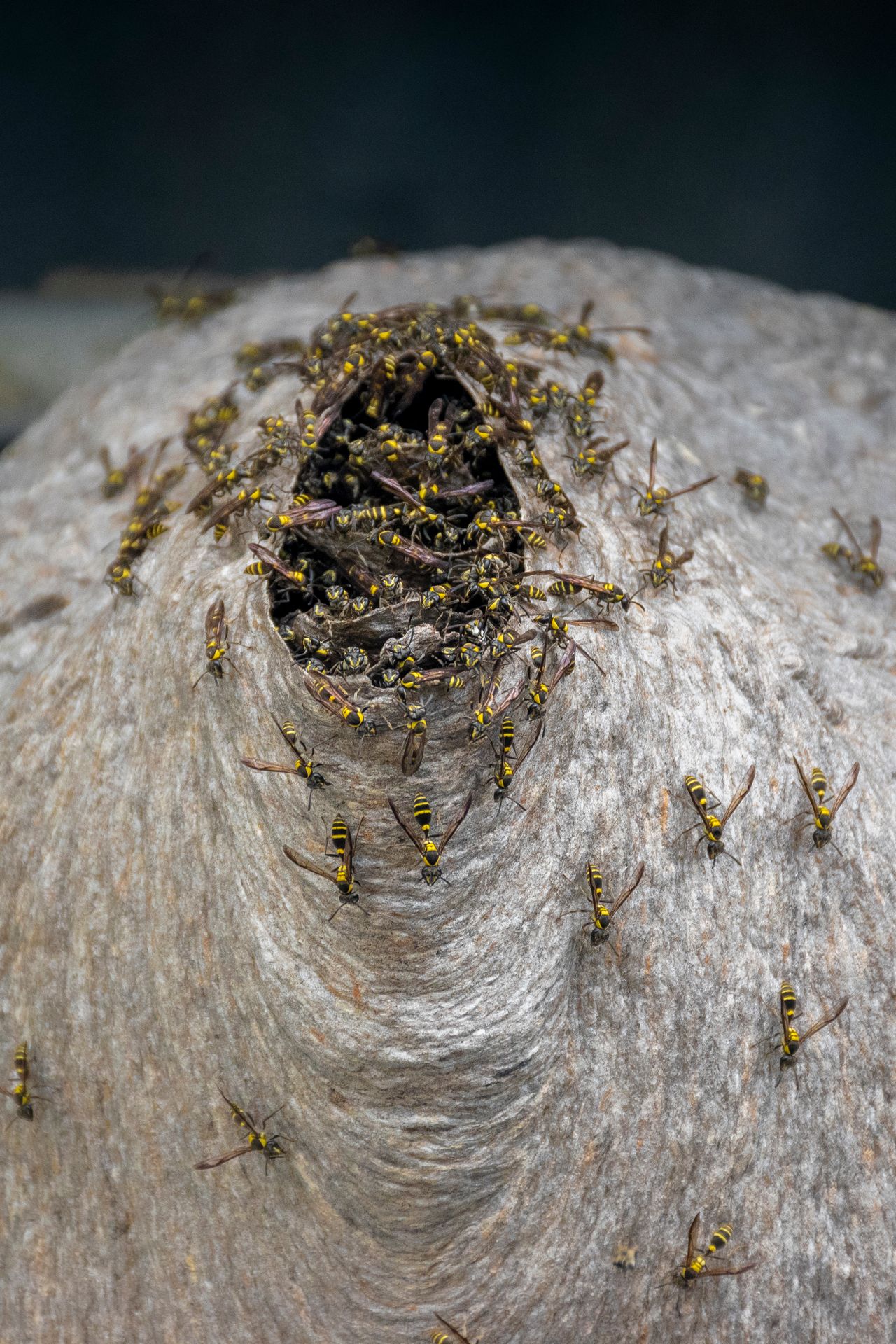
Nothing comes out, and nothing needs to. A wasp nest is paper. Once the colony is dead it dries, goes brittle and collapses in on itself, and it does not attract anything worth worrying about. Wasp nests are also strictly single-use — the colony dies in the autumn and next spring's queens build somewhere new, so an old nest sitting in a cavity is not a reason for a return visit.
Opening a wall or lifting a ground floor to retrieve inert paper would cost several times what the treatment did. The only thing worth doing afterwards is making sure the same hole is not the obvious choice again next spring.
When can I seal it up or fit a new grille?
Activity usually drops sharply within a few hours and is effectively over inside a day or two, but the honest signal is not a date on a calendar — it is what you see at the hole.
- Judge it on a warm, bright day. Mid-morning to mid-afternoon. On a cold or wet day foragers are not flying anyway, so a quiet hole tells you nothing.
- Look for purposeful two-way traffic. Not the odd wasp in the garden — wasps going in and coming out of that specific point. Zero over five minutes on two or three warm days is the signal.
- Ignore the first afternoon. Treated colonies look busy before they go quiet. It is not a failure.
- Expect stragglers. A handful of confused wasps over the following week is normal and is not the colony rebuilding.
- Wait for the autumn to close it. There is no advantage to sealing in August, and a real risk in doing it early. Fit a proper replacement air brick, or a fine stainless mesh over the existing one, once the season has ended. Mesh keeps the airflow. Foam does not.
Wasps coming out of a wall right now?
£60 fixed, same-day across Manchester and Greater Manchester, treated from outside without opening anything. You do not need to work out whether it is the cavity or the eaves above it. Call 07770 015197 and we will tell you on the phone whether it is worth a visit at all.
Call to BookFrequently Asked Questions
No. The treatment goes into the hole the wasps are already using, from outside. No brickwork is removed, nothing is drilled, and no plaster or plasterboard is disturbed. Returning foragers walk through the treatment and carry it into the nest themselves, which is why the nest never has to be reached or seen.
No, and this is the single most common way a cavity nest turns into an indoor problem. Sealed out of their entrance, wasps chew inwards instead. Plasterboard is paper-faced gypsum and they get through it, so they end up in the room rather than the wall. Treat first, then seal weeks later once the entry point is genuinely dead.
A wasp or hornet nest in a cavity wall, a sub-floor void or behind an air brick is £60, fixed — the same as a nest in a loft or a hedge. Awkward access does not change it, and neither does an evening or a weekend. A free return is included if there is still activity a couple of days later.
It could be either, and it does not change what happens next. On a house with a suspended timber ground floor, the air brick vents the void under the floorboards, so the nest is often sitting in that void rather than in the wall itself. Both are treated at the same point, from outside, for the same price.
Because those are holes cut through the plasterboard into the void where the nest is. A downlighter aperture, a ceiling rose cable hole and an unsealed extractor duct all open into the same ceiling or floor void the wall cavity connects to. Wasps in a dark void move towards light, and a lit room is the brightest thing they can see.
Wait until the autumn, once the season has ended, rather than sealing the same week. Activity usually falls away within hours and is finished within a day or two, but stragglers can keep appearing for a week. When you do close it, use a proper replacement air brick or a fine stainless mesh over the existing one, never expanding foam.
No. A dead wasp nest is chewed wood pulp. It dries out, collapses and stays where it is, and no colony ever reuses an old nest — next year's queens build fresh. Opening a wall or lifting a floor to retrieve inert paper costs far more than the problem is worth, so it is left alone.